Foundations of Cognitive Expansion: Toward a Model of Thought for Artificial General Intelligence
Why this Work Matters
The pursuit of Artificial General Intelligence (AGI) demands more than technical prowess—it requires a rethinking of cognition itself. This article introduces a foundational framework for modeling thought in AGI systems, one that reflects how humans evaluate, adapt, and act with purpose. Inspired by childlike learning and rooted in behavior-driven architecture, this work lays the groundwork for simulating context-aware intelligence. The journey begins with cognitive expansion—and leads toward the fusion of classical and quantum models of mind.
Abstract
This paper explores a foundational approach to modeling thought in Artificial General Intelligence (AGI) through a theory of cognitive expansion. We propose that cognition is driven by continuous internal questioning, the evaluation of sensory input, and the dynamic formation and selection of behaviors based on beliefs, values, memory, and environmental feedback. This system-centric view provides a structure for thought as an emergent, recursive process influenced by both data and context. We introduce a behavior-centric architecture composed of key functional modules such as a priority system, behavior templates, consequence evaluators, and adaptive memory layers. The goal is to define a replicable model that enables AGI systems to simulate human-like thought processes with contextual adaptability, self-reflection, and goal alignment.
Introduction
Artificial General Intelligence requires more than problem-solving capabilities—it must exhibit the capacity for contextual understanding, autonomous behavior selection, and continuous cognitive growth. Most current AI systems lack mechanisms for reflective thinking, spontaneous learning, and dynamic value-guided behavior. This paper proposes a foundational model of cognition based on the idea that the mind is a questioning engine: a system that persistently interrogates its environment and internal state to determine relevance, danger, opportunity, and purpose.
We introduce the concept of cognitive expansion as a layered framework of internal processes. At its core, the model starts with sensory input triggering evaluative loops, which determine whether a situation requires attention, action, or memory formation. This model emulates a child-like developmental trajectory, where new behaviors are learned, reinforced, or replaced through consequence-driven evaluation.
Our architecture outlines how thought chains are formed, selected, and evolved. It separates perceptual interpretation, memory interaction, emotional weighting, and motor action into modular components that can be physically distributed or logically virtualized.
System Roadmap
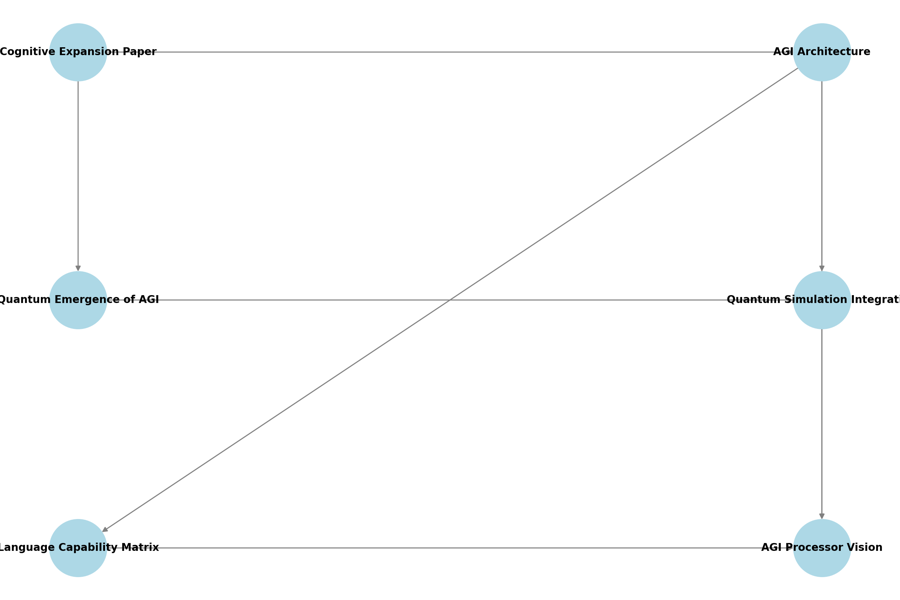
Figure 1: Flow diagram linking cognitive architecture to AGI emergence through quantum simulation.
Figure 1: Flow diagram linking cognitive architecture to AGI emergence through quantum simulation.
Next Steps
Future sections of this paper will detail the following:
- Core Concepts and Architecture Overview
- Behavior Matrix and Priority System
- Consequence Evaluation and Feedback Loops
- Developmental Learning and Skill Acquisition
- Simulation Models and Applications
- Future Integration with Quantum Cognition
Note
This article is part of an evolving series. Future sections will be posted as research continues. If you’re interested in our next work—Emergence of AGI from Quantum Mechanics—watch for upcoming posts under the Articles section.
@ 2025 Otto L. Lecuona